
B.Sc. in food science and technology
Program Profile
- Effective contribution in realizing in human and economic development of the Community by preparing qualified cadres equipped with knowledge, skills and able to deal with modern technology to compete in the labor market, and to provide research and engineering consultancy for community service in way that developing the food industries in country and drive the wheel of the national economy .
- Food science is a scientific, academic, and professional field that interprets and applies principles of engineering, science, and mathematics to food manufacturing and operations, including the processing, production, handling, storage, conservation, control, packaging, and distribution of food products. Given its reliance on food science and broader engineering disciplines such as mechanical, civil, chemical, industrial and agricultural engineering.
- Qualifying specialists in the field of food sciences with knowledge and skills appropriate to the labor market.
- Due to the complex nature of food materials, food science also combines the study of more specific chemical and physical concepts such as biochemistry, microbiology, food chemistry, thermodynamics, transport phenomena, rheology, and heat transfer. Food science and biotechnology apply this knowledge to the cost-effective design, production, and commercialization of sustainable, safe, nutritious, healthy, appealing, affordable and high-quality ingredients and foods, as well as to the development of food systems, machinery, and instrumentation.
- Food scientists study new ingredients with better nutrition and health benefits, and develop new products or technologies to improve the shelf life of the product. A food technologist is not only involved in the food processing, but also in designing of the food plant and various equipment used in processing.
Occupational profiles of graduates
Qualification awarded
B.Sc. in Science in Food Science and Technology
Length of programme
4 years (8 semesters)
Number of credits
240 ECTS credits
Mode of Study
Full time on campus
Read more about the programme
Get detailed information about the programme requirements, courses, credits, and educational objectives as a PDF file.
Program Educational Objectives (PEOs)
- The Program Educational Objectives (POEs) of the Food Science and Technology department (FSST) are to prepare graduates with:
- Rehabilitation and training students scientifically and practically in the field of food science, technology, design, and operation of food manufacturing, and graduate engineers’ technicians to deal with modern technology and development.
- Be able to analyze, design, and provide technical and managerial solutions for food technology systems, and develop new food products in government and private factories.
- Long-life study, be successful in food engineering technology positions and related engineering technology areas as demonstrated by promotions, increased marketing, and food economic outcomes.
- The department offers undergraduate and postgraduate degree programs in Food Science, Food Technology, Quality Control and Food Safety and Nutrition.
- The department aims to develop the capabilities of students, whether in preliminary or postgraduate studies, to be able to meet the community’s need for different nutritional specialties, whether in the field of food manufacturing and preservation, human nutrition, or food health.
- The department is a pioneer and distinguished in education, scientific research, and community service in the field of food industries and quality control in the governmental and private sectors, by providing advice and scientific advice to various food factories and holding scientific seminars and training courses.
Program Learning Outcomes
After completing this programme, students should have:
- To know the food systems, the composition of different foods and milk products, and to understand the principles and practices of food and dairy processing that concern food and dairy product quality.
- To be familiar with traditional and modern food preservation methods, postharvest handling methods, and the uses of food packaging materials to extend the shelf-life of food products.
- Apply obtained skill in food and dairy microbiology to operate a chemical lab related to microbial safety and quality of food, meat, dairy, juice and beverages, confectionery, cereal and bakery products, and other food products
- Analyze market trends, develop marketing skills, and understand the food economy with the potential to start their own business and generate income.
- Understanding the role of food chemistry in human nutrition and supporting health, and the ability to create a daily dietary program for the community and individuals.
- Derive, analyze, and solve hands-on laboratory experiences, analyze chemical and physical tests, understand the nature and sensory properties of food, apply technology to create meat, dairy products, functional food, bakery, sweets, oil, fruit, and vegetables, and being able to develop new food products.
- Operate and maintain food plant machinery, control food quality to manage the unit operations, set up factories, and understand waste utilization, industry, and waste management during food processing.
- Communicate effectively with stakeholders and farmers to promote innovative techniques of production, extension, and training, the ability to work in teams, and present research findings to diverse audiences.
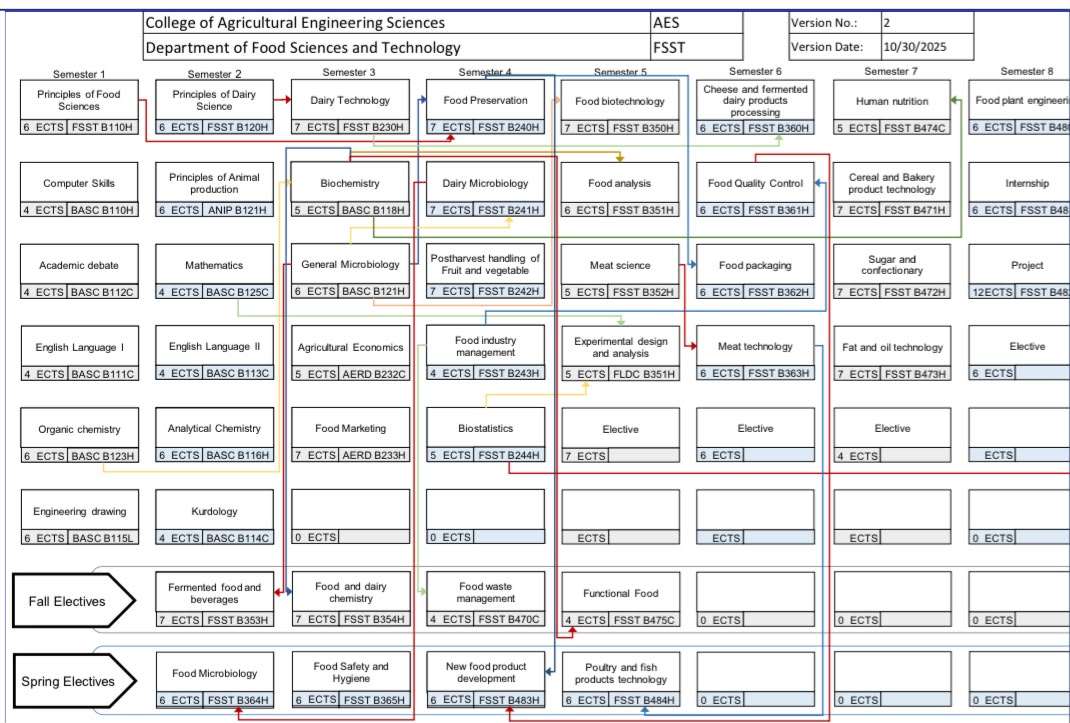
Programme structure diagram with credits
Yearly Timeline
Sept. 1, 2026
⚠️ First year students start around mid-October
⚠️ First year students start exams around 20 of January
July 1, 2027
Check out the full academic calendar on UoD's webstie.
Programme Coordinator

Assistant Professor in Food Science
Food Sciences and Technology
College of Agricultural Engineering Sciences
University of Duhok
Apply to the Programme
Public undergraduate admissions in the KRG region are managed centrally by the Ministry of Higher Education through the online ZankoLine portal (regayzanko.com). After Grade 12 Baccalaureate results are released, high schools provide students with unique login credentials to rank their preferred universities and B.Sc. majors during a 10–14 day registration window. Final placement is automatically determined by the student's Grade 12 average, subject choices, and department capacity.